By Brian D’Ambrosio
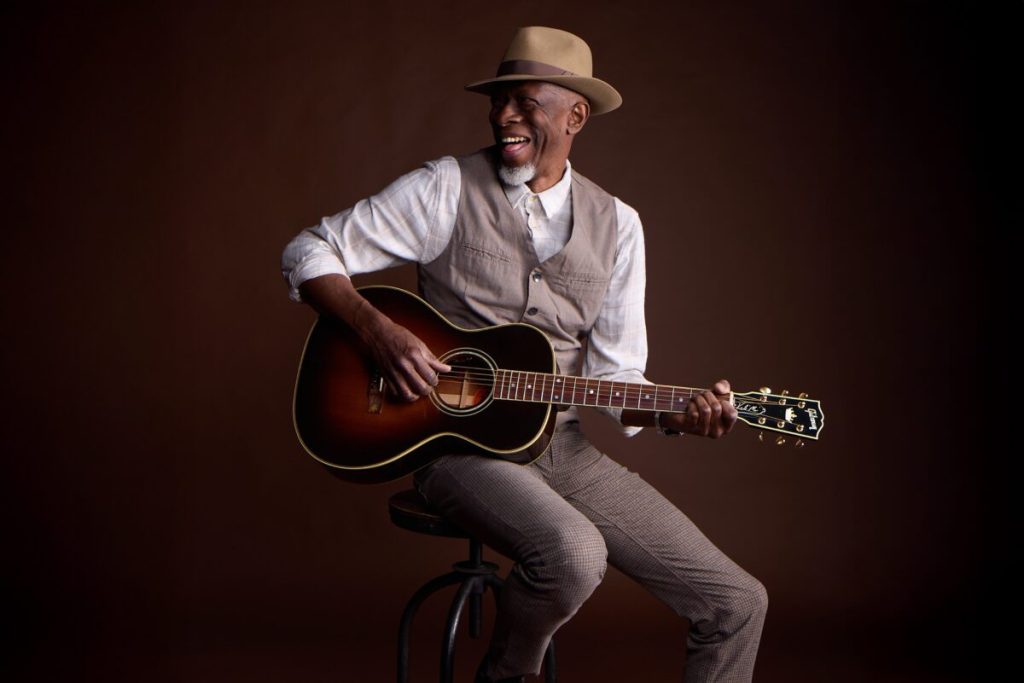
Keb’ Mo’ has been making music for more than half a century, but he still approaches a song like there is something left to figure out. Born and raised in Compton, California, he came up listening to Nat King Cole, church singers and the blues guitarists who traced the music backward toward Mississippi. At 21, he landed a professional gig with Papa John Creach. Two decades of work as a guitarist, songwriter and arranger followed before his 1994 self-titled album introduced Keb’ Mo’ to a much wider audience. Five Grammys, an Americana Music Association Lifetime Achievement Award and collaborations with artists including Taj Mahal, Bonnie Raitt and Willie Nelson came later.
Now 75, Keb’ has made The Breakdown, a remarkably spare record built primarily around his voice and guitar, with the Soweto Gospel Choir and Take 6 appearing on selected tracks. The album was recorded at his home studio outside Nashville after open-heart surgery, the end of his nearly 20-year marriage and a period when, as he puts it, “everything in my life was breaking down.” The album arrived August 21, 2026, and includes “Fussing and Fightin’,” “Every Step of the Way,” “Hand It Over” and “One Day Away.”
The circumstances could have produced a record heavy with regret. Instead, The Breakdown keeps moving. Keb talks about aging and mortality, but also about gratitude, faith, old friends, South Africa, Compton and the simple necessity of staying interested in the work. “I keep myself excited,” he says. “I get bored with myself, so maybe other people might get bored with me too.”
That instinct—to keep listening, learning and moving—runs through Keb’s story.
He remains serious about the instrument that carries the stories. Before recording The Breakdown, he paid particular attention to his voice.
“I do a lot of vocal warming up,” he says. “I warm up my vocals and then I rest. I make sure it’s got air and I’m shaving off the loose hair, you know? I’m not a great singer, but I like to at least be able to tell a story.”
He is equally attentive to the craft behind the songs. Asked whether he knew where “Fussing and Fightin’” was headed from premise to conclusion—from quarry to temple, so to speak—he laughs off the notion of having everything mapped out.
“Well, making a record is always trial and error,” he says. “You’re trying things and deciding what guitar parts work, what doesn’t work.”
The modern music business adds another problem. “Every day, like 800,000 songs come out worldwide,” he says. “There’s so much music being put out there. So you’re trying to figure out how to cut through all that. I just try to communicate authentically and put my best foot forward.”
For Keb, authenticity starts with listening.
He grew up hearing Southern traditions through his family and the church. The family record collection was modest, but there was a stereo by middle school and Nat King Cole on the radio. The church provided something records could not: singers performing in the room, every Sunday.
“The church singers were a major inspiration because I heard that live Southern Baptist tradition every Sunday,” he says. “You’re hearing the African American experience right there. That set a pretty high bar.”
He eventually found his own route through words and melody. He gravitated toward guitar players rather than trying to mimic singers whose voices he could never reproduce.
“I never tried to imitate singers because I couldn’t make their sounds,” he says.
His listening went deep into the blues: B.B. King, Little Milton, Robert Johnson, Son House, Muddy Waters, Howlin’ Wolf, Big Bill Broonzy, Bobby “Blue” Bland and John Lee Hooker. In 1993, he traveled to Greenville, Mississippi, where he studied with Eugene Powell, better known as Sonny Boy Nelson.
“I’m not much of a tourist,” Keb says. “I’d rather listen to the music.”
That same curiosity eventually took him to South Africa, where he encountered the Soweto Gospel Choir. A version of his 1996 song “Hand It Over” sat for four years before he decided to bring it into The Breakdown. He recorded the new version at Flame Recording Studios in Johannesburg.
“To be collaborating with the folks in the motherland was a cool deal,” he has said.
The experience also prompted thoughts about what had been lost between Africa and generations of Black Americans.
“Yeah. I mean, we got robbed,” he says. “As African Americans, we’ve been here for generations, and we lost a lot of the culture of where we came from. But African culture is pretty cool too.”
Faith appears throughout the new album, particularly in “One Day Away,” but Keb describes it as something larger than denomination.
“Faith is universal,” he says. “It’s not necessarily one dominant denomination. It’s the universe, God, whatever you want to call it. Your words and your actions are infinitely connected. What you speak, what you ask for, what you do—it all matters.”
He recalls Florence Scovel Shinn’s phrase, “Your words are your wand.”
“I believe that,” Keb says. “I speak and think things into existence. It keeps proving itself to me. You get out of life what you put into it.”
For all the miles he has traveled, Compton remains close. He still has a small house there and spends time in the neighborhood where he grew up. The title song from his previous album, Good To Be, came together in that house’s garage while he and Money Mark Ramos talked about Los Angeles.
The old neighborhood remains part of his musical vocabulary, just as the old musicians do.
So does Taj Mahal, whom Keb first heard perform during his senior year of high school. He later opened for him and eventually made two records with him. The two are preparing to tour together again.
And there are still the old friendships: drummer Quentin Dennard, whom Keb met through Los Angeles recording sessions; Papa John Creach, who hired his young band in the early 1970s and took them on the road; the guitars built by Larry Pogreba; and the $25 Sears & Roebuck steel guitar he once owned before losing it in a flooded Nashville storage locker.
The objects disappear. The songs remain.
After more than 50 years, Keb’ Mo’ is still looking for the next sound, the next story, the next reason to pick up the guitar.
“I keep myself excited,” he says. “I get bored with myself. I have to find something that makes me want to keep going.”

