An immigrant and political exile from Italy spent a quarter century painting the national capital and its buildings with works of art.

By Brian D’Ambrosio
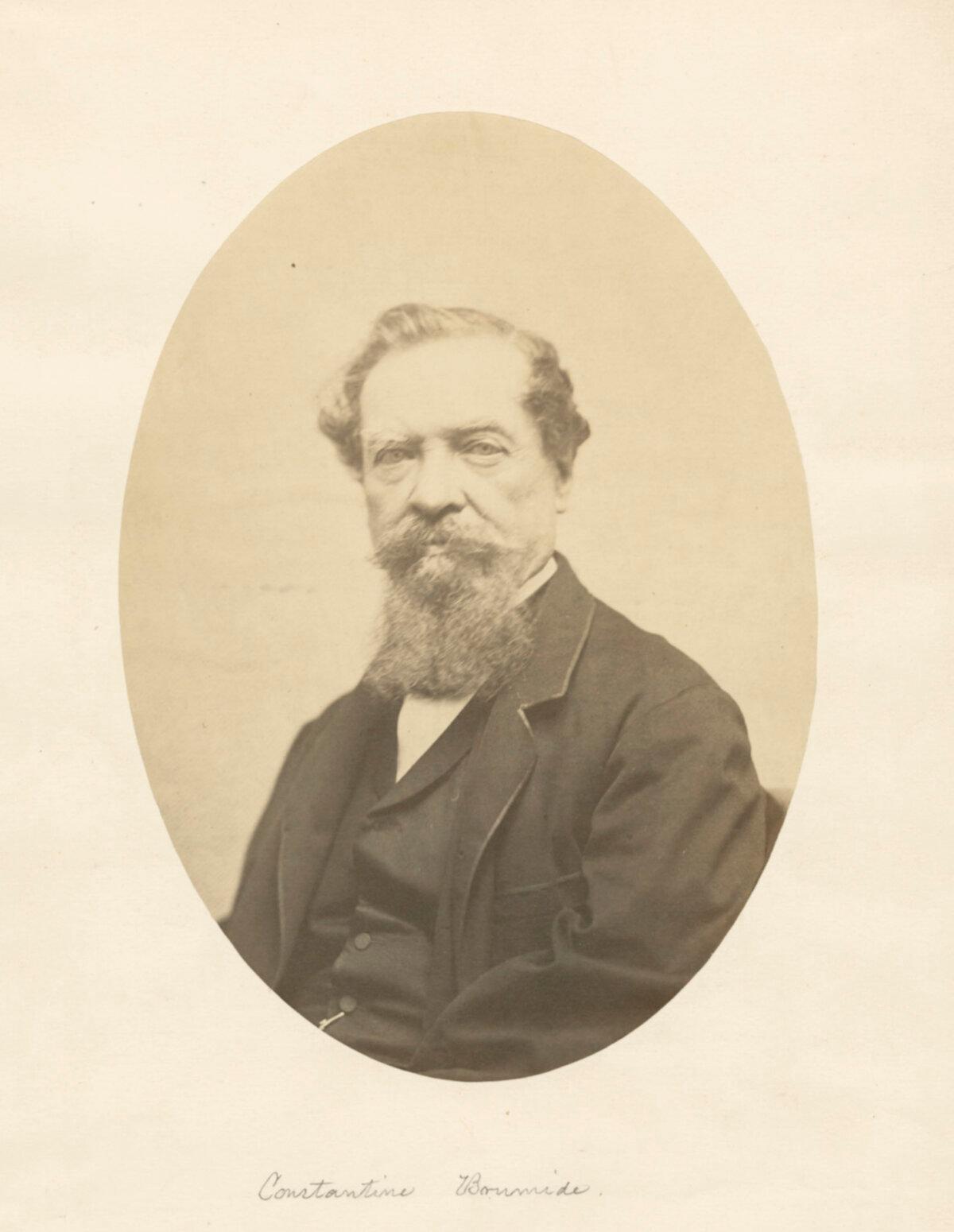
Constantino Brumidi arrived in the United States in September 1852 as a refugee from turmoil in Europe. He had experienced the violence wrought from intractable political differences and the brutality of living under an oppressive rule. He had been imprisoned in part for his participation in a rebellion for freedom and reform.
Released by Pope Pius IX on the condition that he must leave Italy, the 47-year-old artist immigrated to a young nation of promise and possibility an ocean away. Before long, the Greek-Italian painter was a firm proponent of the virtues of American democracy and a staunch, proud advocate of the freedoms and foundations that made it such a hopeful contrast to the country that banished him.
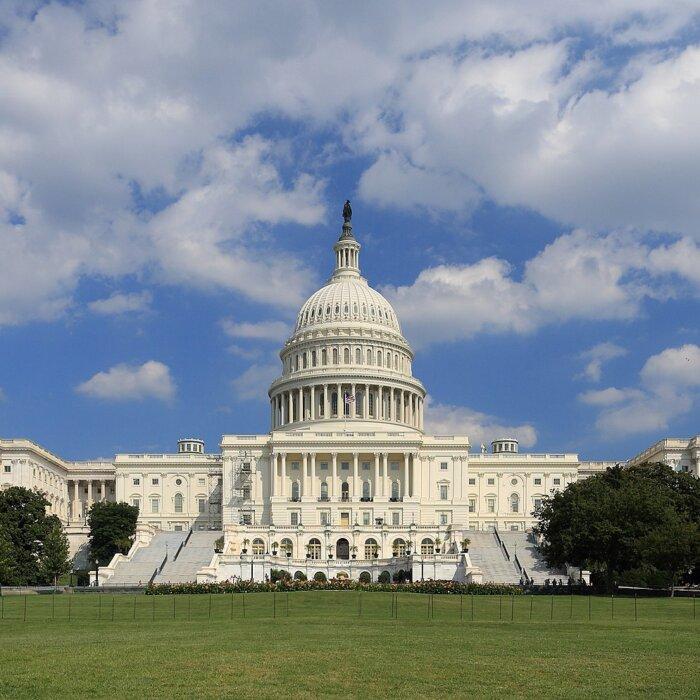
In the annals of American artists, his name is, for the most part, unfamiliar, but his finest and most ambitious works are at the U.S. Capitol. He labored on various projects there for 25 years, through six presidents terms—from Franklin Pierce to Rutherford B. Hayes. His paintings continue to be been seen and appreciated by thousands of visitors daily.
A Fresco Painter Comes to America
Born in 1805 in Rome, Brumidi seemed destined to be a good artist and an excellent fresco painter. Even from his boyhood, he studied long hours and days in Rome and received instruction from some of the most important art schools in Italy. He received formal training in painting and sculpture from renowned masters, studying under Danish-Icelandic sculptor Bertel Thorvaldsen, a long-time resident of Italy; Antonio Canova, a neoclassical sculptor renowned for his marble sculptures; and Baron Vincenzo Camuccini, one of the foremost painters of the day.
And on top of this, Brumidi learned proficiency in classical and Renaissance painting methods, such as true fresco, or “buon fresco,” painting on wet plaster with water-based pigments. He was heavily influenced by the finest painters of the Italian Renaissance, including Raphael, a master of fresco.
In the 1840s, he was employed to make frescoes and decorate the villa and Prince Torlonia’s palace in Rome and worked for the Vatican for three years under Pope Gregory XVI, restoring frescoes in the Vatican Palace and adorning churches and palaces in Rome.
Brumidi was caught up in the tumultuous activities besieging Italy from 1848 to 1849, during which he joined the Roman Republic, a transitory, revolutionary state opposing the Pope’s temporal powers.
After the Pope regained power, Brumidi was put on trial for his role in the movement and prosecuted for removing valuable church artworks from various locations, which he claimed was to protect them from vandalism. He was convicted and sentenced to 18 years in prison. He served only 14 months, however, before he was conditionally pardoned by Pope Pius IX.
Artist Citizen of the US
Brumidi agreed to leave Italy as a requirement of his pardon, and he subsequently immigrated to the United States. He arrived with old world judgments but New World openness. He stepped off the ship in New York City with voluminous knowledge, as well as razor-sharp memories of the turmoil that had ripped apart the land of his birth. But of even greater magnitude, he brought with him the traditional techniques of fresco painting, a method practically unheard of in this surrogate nation at the time.
Eager to embrace a new identity, he applied for U.S. citizenship upon his entry, and, eager to put his previous skills to new purposes, he quickly received private and church commissions for work in New York and Massachusetts. Subsequently, Brumidi painted altarpieces and murals in churches in Philadelphia and Baltimore and decorated the entrance hall of Saleaudo, a home located in Frederick County, Maryland.
Brumidi’s talent and personal qualities allowed him to form contacts and relationships with well-connected people who helped him use his talents, advance his career, and publicly share his passion and taste for the fine arts. In due time, he was honored with significant duties, applying his abilities with singular commitment to enhance the aesthetics of one of America’s most important public buildings.
‘Michelangelo of the Capitol’
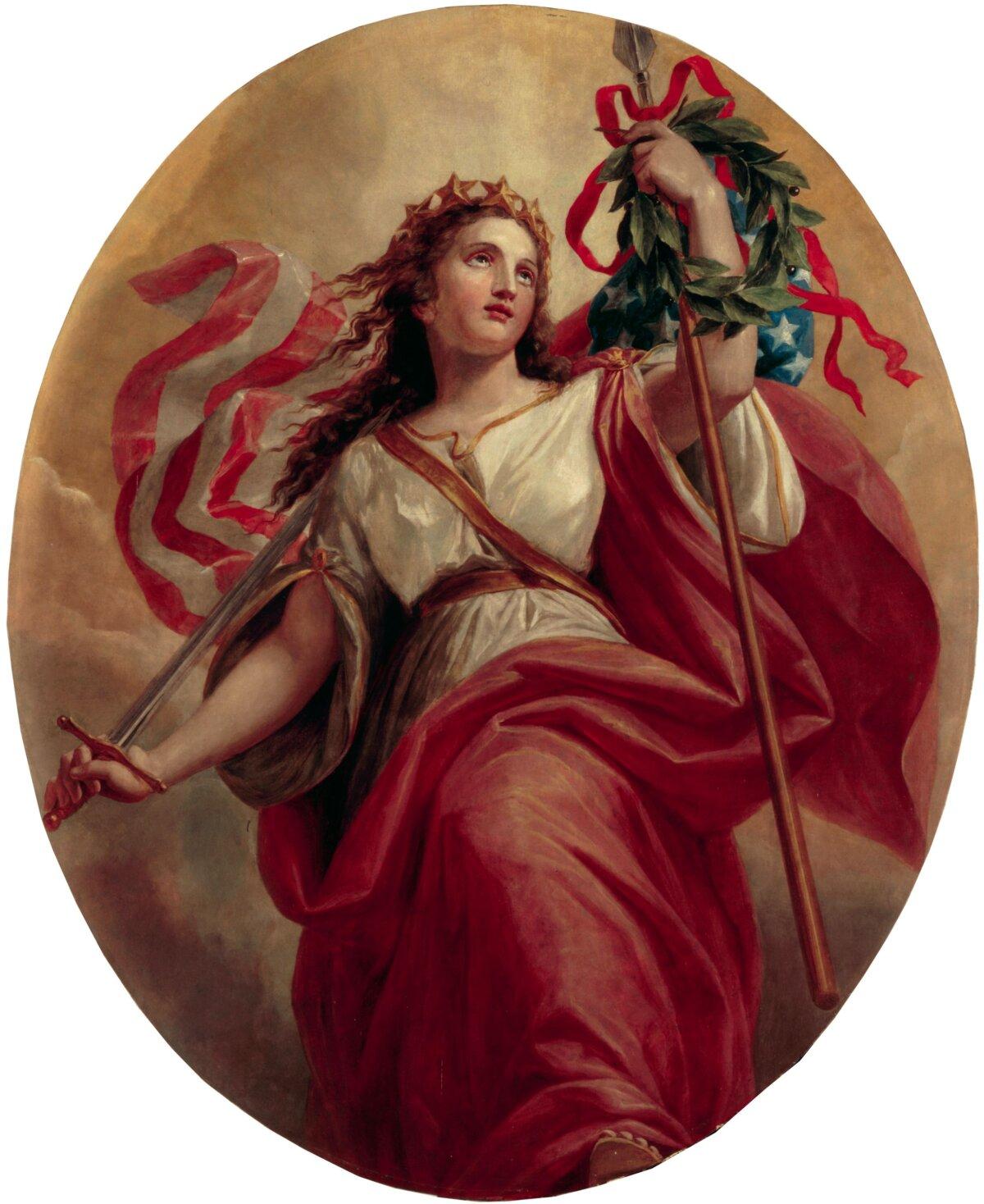
In 1854, he was hired as the chief fresco painter for the U.S. Capitol by Capt. Montgomery C. Meigs (1816–1892), a distinguished U.S. Army officer. His first work at the Capitol was a test mural in the House Committee on Agriculture room. The work commenced in 1855, and he was initially paid $8 a day. “Calling of Cincinnatus From the Plow,” which represents portraits of George Washington as the “American Cincannutus” and allusions to the self-determining importance of agricultural strength, is recognized as the earliest example of a true fresco painting in America. The fresco can now be found in Room H-144 in the U.S. Capitol.
From the time of that first Capitol fresco to the time of his death, Brumidi continuously painted murals and frescoes in the U.S. Capitol. Driven by more than just an ordinary set of artistic and professional desires, Brumidi articulated a burning desire to beautify the Capitol out of strong political and national affiliation: “My one ambition and my daily prayer is that I may live long enough to make beautiful the Capitol of the one country on earth in which there is liberty.”
With each passing year, Brumidi’s fondness of his adopted country strengthened. Five years after he had applied, he was approved as a naturalized U.S. citizen in 1857, from then on commonly signing his work as “C. Brumidi, artist Citizen of the U.S.”
He was trusted to decorate more rooms and corridors within the Capitol, including a chain of five elaborately decorated hallways on the first floor of the Senate wing. These are referred to as the Brumidi Corridors.
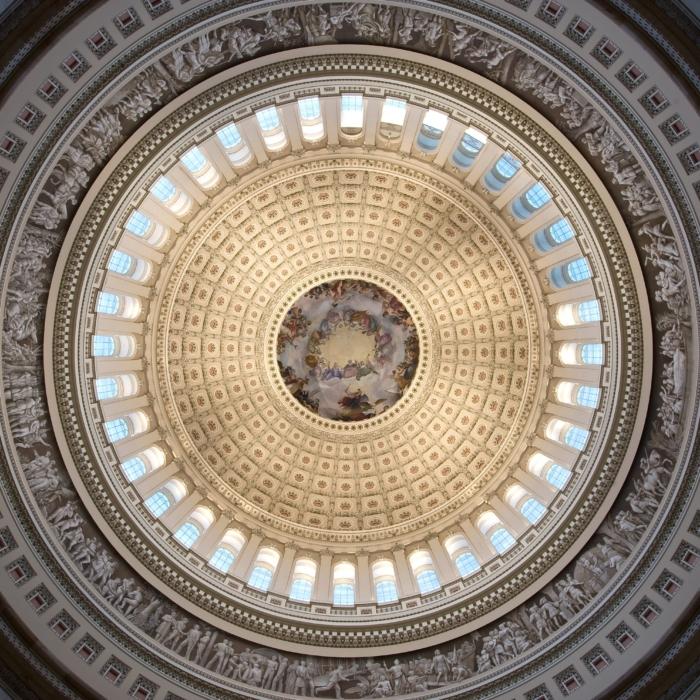
His greatest contributions, however, are widely considered to be “The Apotheosis of Washington” and “The Frieze of American History.”
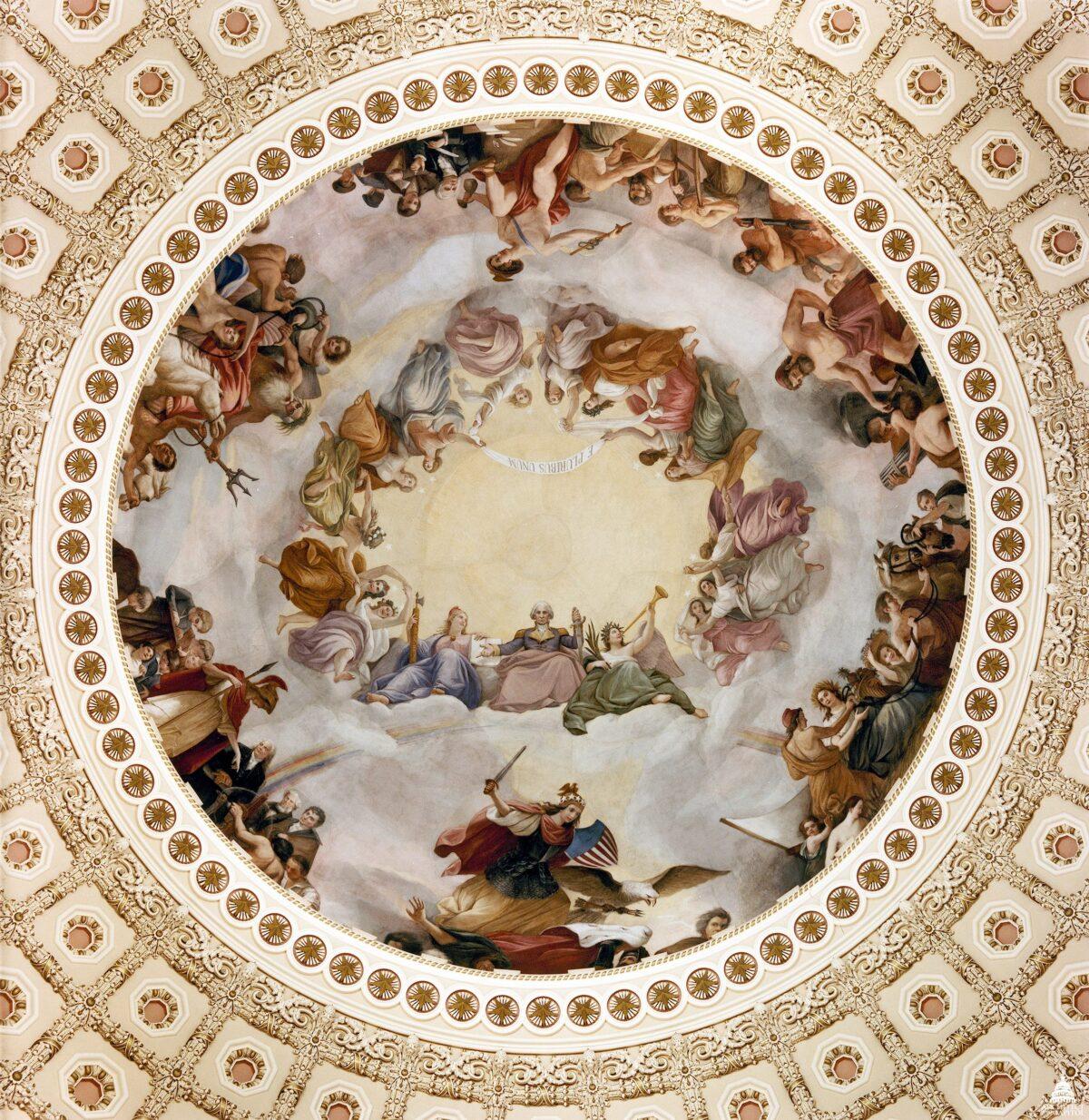
Classical in subject and artistic in execution, “The Apotheosis of Washington” is an excellent specimen of Brumidi’s nuanced skill. Located on the canopy of the Capitol Dome’s rotunda, the work, which was completed in 1865, depicts Washington in his military uniform, ascending to the heavens and 13 female figures signifying the original Thirteen Colonies.
In 1878, Brumidi began painting “The Frieze of American History,” which depicts major events in American history chronologically, beginning with the landing of Columbus in 1492. However, he died before its completion, and artists Filippo Costaggini (1839-1904) and Allyn Cox (1896-1982) finished the frieze based on Brumidi’s designs.
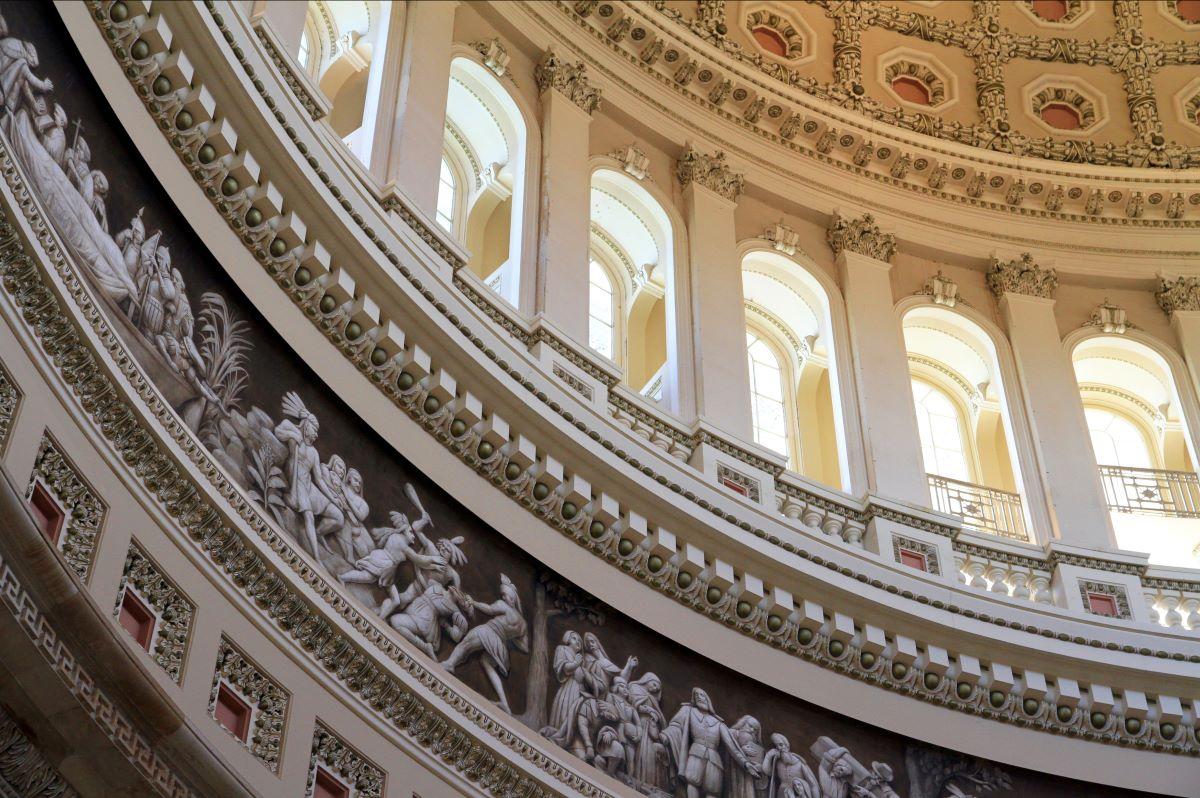
In April of 1879, a reporter from The Washington Post interviewed Brumidi as he was working on “The Frieze of American History.” The reporter, noticing the 73-year-old man’s fragile physical state, asked Brumidi if such hard work was beyond his strength.
Underscoring his devotion to his art, his country and to the U.S. Capitol, Brumidi said: “Oh, no, I am not so strong as once. I cannot walk well, or stand, but my arm has lost nothing; my hand and my eye are as good as ever,” Brumidi said. “It is my life-long work.”
Months later, Brumidi died in Washington on Feb. 19, 1880. His unmarked grave at Glenwood Cemetery remained that way for 72 years until its rediscovery. A marker was placed on it Feb. 19, 1952.
Posthumously, Congress awarded Brumidi the Congressional Gold Medal in 2008 in recognition of his eminent contributions to the U.S. Capitol. Indeed, the Capitol serves as an ongoing monument to the impressive mastery and imagination of a great artist and wholehearted citizen.
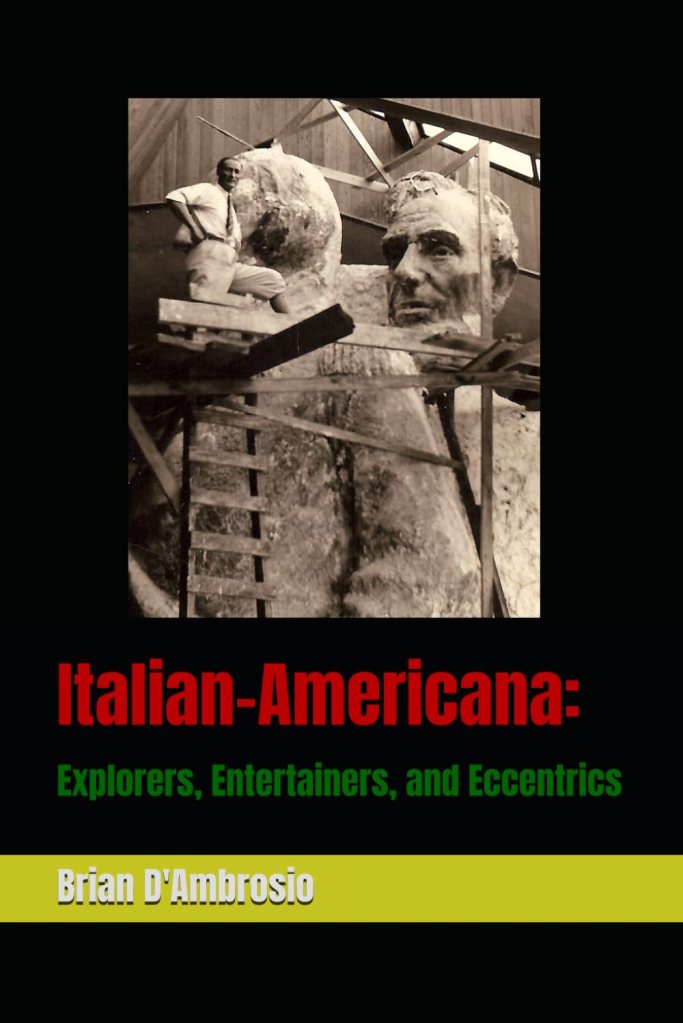
Brian D’Ambrosio is the author of Italian-Americana: Explorers, Entertainers, and Eccentrics, a collection that profiles over forty Italian-American figures, ranging from historical figures like Amerigo Vespucci to modern entertainers. The book explores themes of resilience, innovation, and the complex, often contradictory legacy of Italian contributions to American culture and history.
 Brian D'Ambrosio