By Brian D’Ambrosio
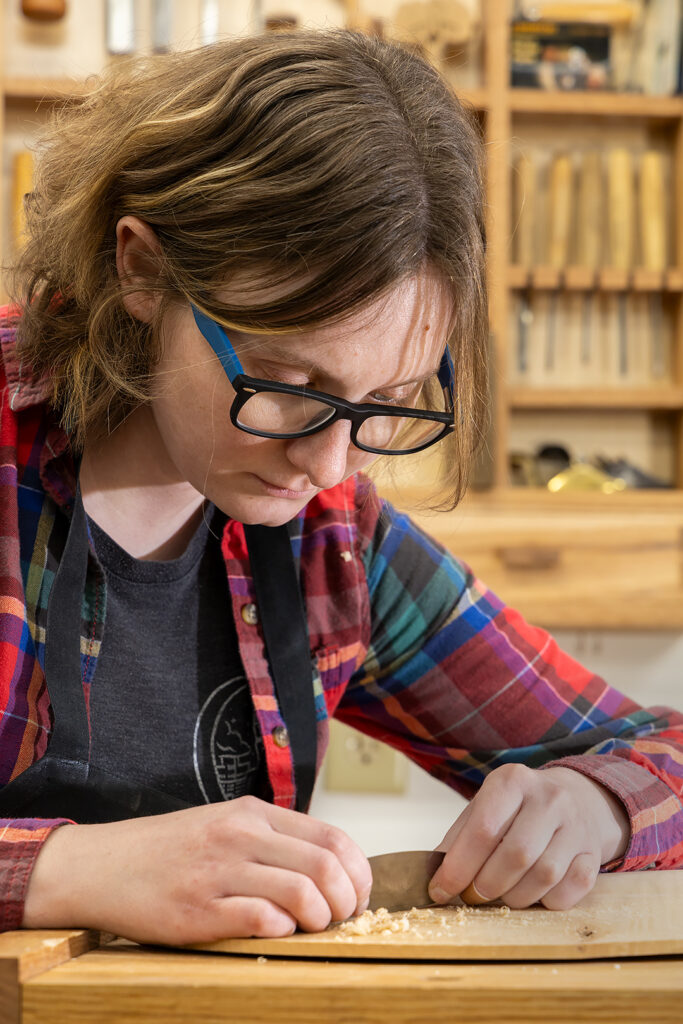
In a small, sunlit workshop in Albuquerque, New Mexico, Klarissa Petti carefully lifts a cello back, tracing the subtle flame of the maple with her fingers. Each curve, each grain line, holds a story. “Every piece of wood has its own voice,” she said. “My job is to help it sing.” It’s a rare pursuit in a world dominated by mass production and digital shortcuts: handcrafting violins, violas, and cellos from raw wood, entirely by one person’s touch.
Petti’s path into this unusual craft began with music, not woodworking. A voracious reader as a child, she discovered classical recordings while exploring literature and decided to start playing the cello at fourteen. “Music opened a door,” she recalled. “It allowed me to express myself when I had no other outlet. Some of the most meaningful friendships in my life grew from it.” By high school, she was attending orchestra camps, buying scores, and attending every Philharmonic concert she could, completely immersing herself in the classical world.
Her love for music eventually led her to the University of New Mexico (UNM), originally drawn by its cello program. A conversation with her cello professor, David Schepps, changed everything. “I mentioned I was interested in violin making, and he told me there just happened to be a class,” she says. That class became her first exposure to luthiery—a craft that would demand patience, precision, and devotion few could sustain. Over three years, she learned the basics of carving, assembly, and acoustics, all while balancing a full college curriculum.
Apprenticeship with a Master
Seeking to go beyond the classroom, Petti reached out to David Caron, a master luthier in Taos, New Mexico, whose career spanned more than six decades. Caron had retired, but his curiosity and love for teaching drew him out of retirement. “I didn’t think he would take me on,” Petti recalls. “It took months of encouragement before I asked. To my surprise, he said yes.” Caron had originally intended to pass his craft to his daughter, who tragically died of cancer in 2000. In Petti, he found someone eager, patient, and willing to absorb decades of accumulated knowledge.
For eight years, Petti traveled to Taos once or twice a month, often spending several days at a time in Caron’s workshop. “We would work eight hours a day,” she says. “He’d demonstrate techniques, show his experiments with arching and tone, and I’d try to replicate and understand them.” Over time, their work evolved into friendship. “He didn’t just teach me how to make instruments,” Petti says. “He taught me how to think about sound, wood, and the unusual patience this craft demands.”
Caron passed away in December 2024 at the age of 83, but his influence continues. Petti now carries forward his legacy of innovation and precision, blending it with her own evolving artistry.
The Craft: Precision, Patience, and Individuality
What makes Petti’s work unusual is the degree of control and intimacy required at every stage. “Every instrument is different,” she explained. “Even within traditional forms, there are endless variations. Arching—the curve of the plates—is what determines how it breathes and projects. That’s what David focused on most.”
The materials themselves are carefully chosen. Spruce is used for the top, maple for the back, sides, and neck, often flamed to enhance resonance. Petti experiments with cherry, willow, and poplar, noting how each wood influences tone. She measures thicknesses to within two-tenths of a millimeter, a painstaking task that can take days for a single cello top. “It’s not glamorous work,” she says, “but it’s where the magic happens. This is what separates a hand-built instrument from a factory model.”
Other steps, like purfling—the delicate inlay outlining the plates—and carving F-holes, combine artistry and acoustics. “F-holes aren’t just decorative,” she says. “They shape the sound, control vibration, and give the instrument its voice.” Small variations in placement or curve can significantly affect projection and tonal balance.
Petti emphasizes that the process for violins, violas, and cellos is largely the same; what changes are proportions, arching, and subtle design adjustments. “A viola is more adaptable, a cello demands larger scale and strength,” she says. “But the underlying principles—the science and art of resonance—are the same.”
Petti also teaches violin making at UNM, returning to the classroom where her own journey began. “It takes about five semesters to complete a violin,” she said. “I learn as much from my students as they do from me. Seeing how different people approach problem-solving helps me rethink my own work.” Teaching reinforces the unusual, hands-on approach she values: observing, adjusting, and learning from mistakes.
Her instruments are crafted primarily for professional and advanced musicians. “I want players to feel that the instrument is alive,” she says. “It should respond to them, inspire them, and be a partner in making music.”
A Living Legacy
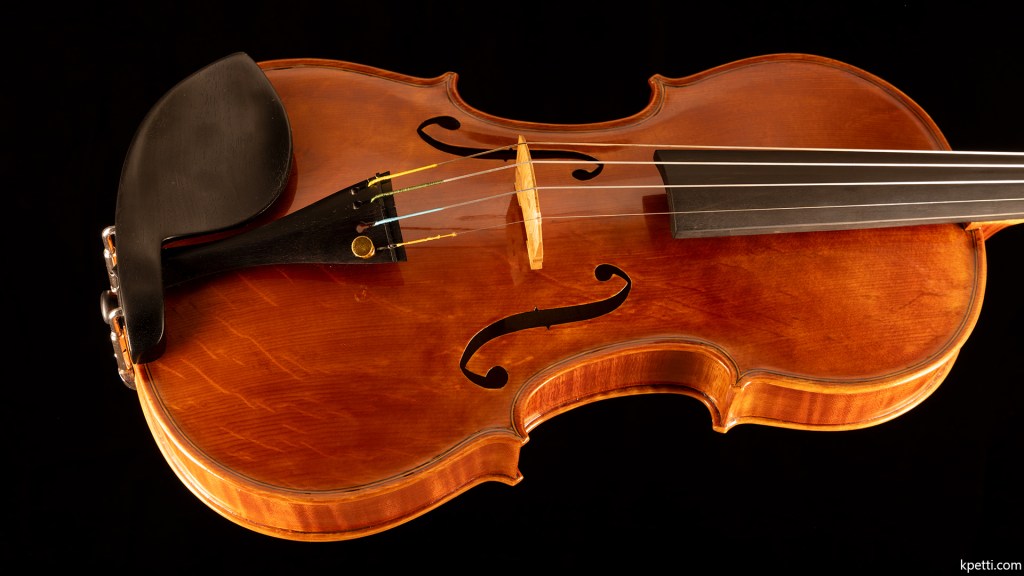
In a world increasingly dominated by digital tools and automated production, Petti’s work is a rare testament to human patience, curiosity, and skill. Her hands shape sound literally and metaphorically, carrying forward Caron’s innovations while adding her own voice. Every curve, every grain, every tiny adjustment embodies decades of accumulated knowledge and the quiet devotion of a single maker.
“The unusual thing about this work,” she reflected, “is that it demands total focus, endless patience, and a love for the materials themselves. You can’t rush it. And if you approach it fully, it gives back in ways you never expect.”
In Petti’s Albuquerque shop, among curls of maple shavings and the aroma of fresh varnish, the past and future meet. Through her hands, the lineage of stringed instrument making continues, alive in wood, in tone, and in the echoes of a master who taught her that music is made as much in silence as in sound.
Excerpted from the book, “New Mexico Eccentrics.” Brian D’Ambrosio is the author of New Mexico Eccentrics. He may be reached atdambrosiobrian@hotmail.comAmazon: https://www.amazon.com/New-Mexico-Eccentrics-Brian-DAmbrosio/dp/1257192620.Facebook: https://www.facebook.com/
 Brian D'Ambrosio