Mar 31, 2026
By Brian D’Ambrosio
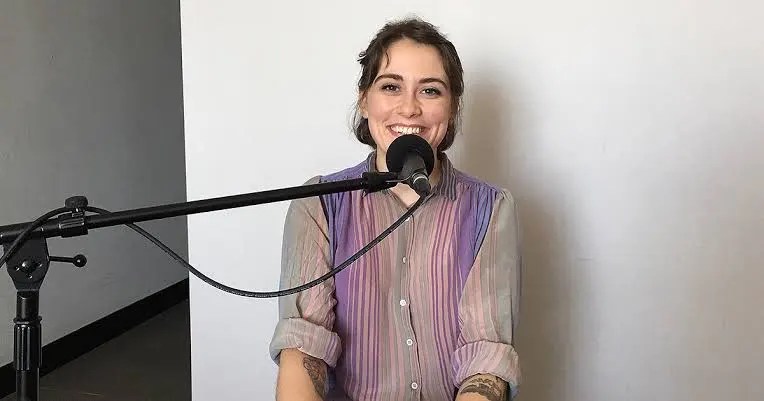
There is a long stretch of road in Canada where the land seems to empty itself of everything but distance. Gas stations thin out, forests close in, and the horizon feels less like a destination than a state of mind. It was along one of those drives, somewhere between Ontario and Manitoba, that Ellen Froese—tired, smoking too many cigarettes, and alone with her thoughts—began shaping what would become one of her most enduring songs, “I Wish I Had a Foot-Long Cigarette.”
“I was just kind of talking into my phone,” she recalls of that trip home after her first cross-country tour as a teenager. “I was feeling like shit.” The result was a song that captures longing in its rawest, most unguarded form—a restless desire for something more, something just out of reach. It remains, perhaps, the clearest window into Froese’s artistic instinct: to take fleeting, messy emotion and give it a shape that lingers.
That instinct was formed far from any music industry hub. Froese was born and raised on a small, 30-cow dairy farm north of Saskatoon, Saskatchewan—the same land her mother grew up on. Her father, a first-generation dairy farmer from the Netherlands, helped shape a life defined by routine, isolation, and quiet persistence. An only child, Froese grew up largely in her own company, homeschooled and left to navigate long stretches of time with books, music, and her imagination.
“I had a lot of time to myself,” she says.
Those hours were not empty. They were filled with the voices of artists who would quietly influence her sensibility: Gordon Lightfoot, Leonard Cohen, Pete Seeger, Mahalia Jackson, Nina Simone, Johnny Cash. She devoured music the way some children devour conversation—checking out stacks of CDs from the library, uploading them, and listening without hierarchy or expectation. It was less about forming taste than building a relationship with sound.
Her upbringing, she admits, was “an interesting cocktail.” A blend of Mennonite roots on her mother’s side—liberal-leaning but culturally present—paired with the independence that comes from being an only child in a remote place. That independence, perhaps, became both her strength and her burden. “It would have been kind of nice to have a sibling,” she reflects. “I don’t know what that relationship is like.”
If solitude shaped her early life, it also shaped her music. Froese’s songs often feel like internal monologues—half-spoken thoughts, drifting observations, moments of humor brushing up against something darker. There is a looseness to them, but also a quiet precision. She does not force meaning; she lets it surface.
At 26, she left Saskatchewan for Toronto, stepping into one of Canada’s most vibrant music scenes. It was, by any measure, a leap. In Toronto, she found a world where musicians could make a living—but often by grinding through multiple gigs a day, immersed in a constant churn of activity.
“It was overwhelming,” she says. “Very anxiety-inducing.”
Living downtown, surrounded by noise and motion, Froese found herself unmoored. The pace, the pressure, the sheer density of it all began to wear on her. “My mental health was pretty bad,” she admits. “I needed to go back home just for my own sanity.”
The return to Saskatchewan was not a retreat so much as a recalibration. Froese had tested herself against a larger world and discovered something essential: she worked better in smaller spaces, in communities where connection felt more immediate and less transactional. “I just do better in a smaller place,” she says simply.
Still, the struggles she carried did not disappear with geography. Froese was diagnosed with ADHD at 28, a revelation that reframed much of her life. What had once felt like personal failings—difficulty focusing, trouble completing tasks, cycles of intense interest followed by exhaustion—became part of a broader neurological landscape. “If I’m into something, I can go so hard on it. And then as soon as that feeling passes, I’m done,” she explains. Learning to work with her attention and emotional patterns has become a central part of both her life and her music.
Her latest LP, Solitary Songs, is a reflection of that balance: an exercise in honesty, patience, and self-acceptance. “I allowed myself to express a bit more with ease,” she says of the album, which was recorded in a week with friends who doubled as collaborators and cheerleaders. There is a sense throughout the record of a musician who has begun to make peace with herself, who no longer measures creativity against external validation but instead follows her instincts wherever they lead.
Even in its quiet moments, Froese’s work bears traces of struggle—the anxiety, the depressive tendencies, the existential musings that can pull her into dark spaces. Yet those threads are never simply confessional; they are transformed into music that is intimate and expansive, grounded in experience but reaching toward universality. From the wide skies of Saskatchewan to remote festivals in Yellowknife, Froese’s songs capture both the loneliness and the wonder of a life lived on her own terms.
Music, for Ellen Froese, is both compass and sanctuary—a way to hold the quiet, and perhaps, to make sense of it.
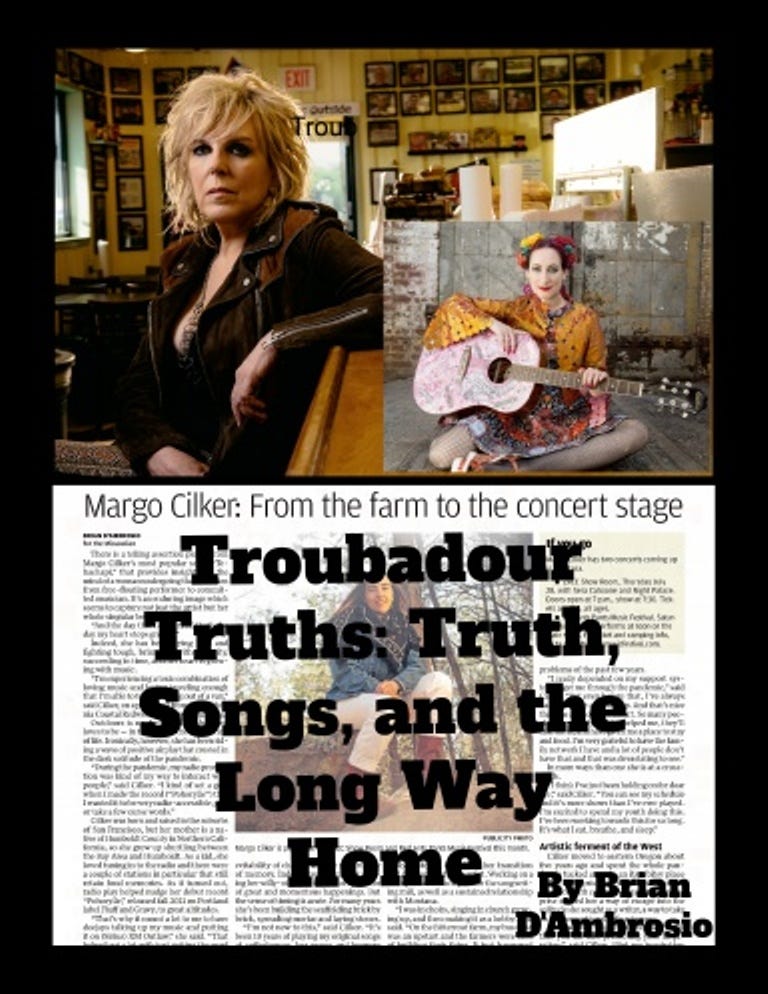
Brian D’Ambrosio is the author of Troubadour Truths: Truth, Songs, and the Long Way Home, a compilation of expansive interviews with singer-songwriters, including John Hiatt, Lucinda Williams, and Greg Isakov.
 Brian D'Ambrosio