

By Brian D’Ambrosio
For Dale Watson, music started at home, not on a stage. It came from the next room, early in the morning, when his father picked up a guitar.
“I would wake up to my dad playing,” Watson says.
That introduction opened the door to a lifetime of listening. Records spun by George Jones, Hank Williams, Charlie Pride, Willie Nelson, Waylon Jennings, and Bob Wills filled the house. Watson didn’t just hear them—he absorbed them. Later, he inherited his father’s record collection. Much of it was lost to water damage after a fire, but what remained, he says, is “precious.”
Those early sounds stayed with him as he grew up in Pasadena, Texas, a refinery town where life was practical and often hard. Music wasn’t an abstract dream—it was something you held onto. Something you carried forward.
He carried it into bars long before he was old enough to be in them.
“I played a place that had chicken wire,” Watson says. The gig was in La Porte, just outside Pasadena. Floodwaters nearly kept the band from arriving, and when they finally did, the room was nearly empty. “We were horrible,” he admits. “Halfway through the gig, they said, ‘Boys, you gotta go home before you get hurt.’”
He was about 14 years old.
The chicken wire wasn’t decoration. It was protection, a barrier between band and crowd in places where things could turn fast. Watson saw it firsthand. “That was a real thing,” he says. “They didn’t just make that up for the movies.”
Those early nights—rough, unpredictable, sometimes cut short—taught him what no rehearsal could. You learned to hold a room or lose it. You learned what worked and what didn’t. And if you stayed with it, you found your way.
By the time Watson settled into Austin, he had begun to shape something that felt like his own. The city, then still smaller but already alive with music, gave him room to figure it out. At places like the Broken Spoke and the Continental Club, he played long sets and watched how crowds reacted. In one club in the 1980s, he was required to play three straight hours of original material—no covers, no breaks.
“I didn’t have enough songs,” he says. “So I’d just make them up on stage.”
Some disappeared as quickly as they came. A few stuck. He would remember them, finish them later, and add them to his growing catalog. The exercise gave him something lasting—confidence. Even now, he still writes that way, pulling songs out of the moment when the room feels right.
It’s part of why no two shows are the same. Watson doesn’t use a set list. He reads the crowd, follows the energy, and lets the night take shape on its own.
“I get easily bored,” he says. “If I had to do the same thing every night, it wouldn’t work for me.”
Before music took over completely, Watson hedged his bets. He enrolled in truck driving school, thinking he’d play on weekends and make a steady living during the week. His father had been a truck driver. It made sense.
“I already had a kid,” he says. “I thought, you’ve got to do something.”
He nearly finished the program. Then the phone rang. A label had heard his material and wanted to put out a record. Less than a year later, he was in England receiving an award for that same project.
“The truck driving school was six weeks,” he says. “Music came easier.”
That path would bring him into contact with the artists who had shaped him. He met Merle Haggard, Buck Owens, and Ray Price. Willie Nelson became both influence and supporter, giving him opportunities and spreading the word. “Willie’s super important to me,” Watson says.
One moment, though, stayed with him more than most.
At a tribute show in Los Angeles, Watson was asked at the last minute to perform a medley of songs by Roger Miller. Midway through, he blanked on a transition. To cover it, he slipped into a familiar trick—the low, steady hum associated with Johnny Cash.
After the show, Cash approached him backstage.
“He said, ‘Let me talk to you,’” Watson recalls. Cash told him that when Roger Miller used that hum, it was a quiet way of saying “I love you.” When Watson did it onstage, Cash said, he and June Carter reached for each other’s hands.
For Watson, it was a moment that said more than applause could.
His music has always stayed close to those roots. He doesn’t shy away from the word “derivative.” He leans into it.
“I 100 percent derive my music from the roots,” he says. “Your originality comes in your failure to imitate your influences.”
That approach runs through his latest album, Unwanted. The record carries the same foundation—honky-tonk, western swing, rockabilly—but the songs are shaped by experience that only time can bring.
“Willie Waylon and Whiskey,” one of the album’s defining tracks, came together in a San Antonio honky-tonk. Watson noticed a man standing in front of the stage wearing a shirt with those three words printed across it.
“I asked him about it,” Watson says. “He said he just liked it. I said, ‘I like it too,’ and we started the song right there.”
By the second chorus, he knew it was staying.
Another song on Unwanted, “If You Really Love Me (Outlive Me),” comes from a different place entirely. It deals with loss, and the uneasy truth that no one wants to talk about—who goes first.
“I lost a girlfriend in a wreck,” Watson says. “That’s the worst kind of heartbreak.” The song grew out of that experience, and from the conversations people avoid having. “Nobody wants to talk about death,” he says. “But you’ve got to.”
The contrast between the two songs—one sparked by a barroom moment, the other by grief—captures something essential about Watson’s writing. It’s drawn from wherever life happens, whether that’s a crowded dance floor or a quiet conversation no one wants to start.
After decades on the road, Watson still finds that connection in the crowd. If anything, it has deepened. He now sees multiple generations in front of him—fans who grew up with his music and their children standing beside them.
“That’s what keeps me going,” he says. “I’m still doing the same thing I was doing back then. I’m still writing songs.”
The tools haven’t changed much. The influences are still there. The approach is the same.
He’s still building, as he puts it, with that old hammer.
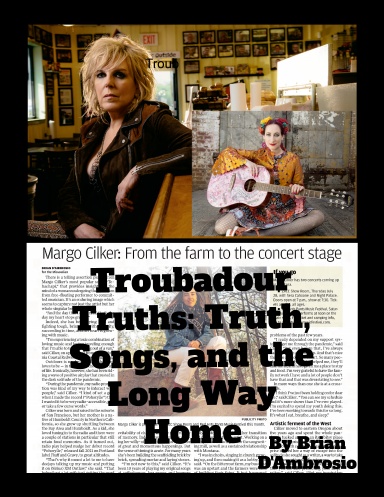
Brian D’Ambrosio is the author of Troubadour Truths: Truth, Songs, and the Long Way Home.
 Brian D'Ambrosio
Leave a comment