
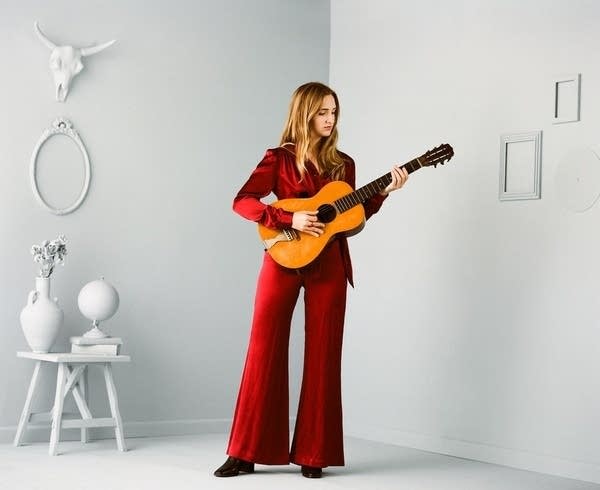
By Brian D’Ambrosio
At 29, Madison Cunningham is standing at the edge of a threshold, looking backward and forward at the same time. In a year, she’ll leave her twenties behind—a decade she describes with a mix of nostalgia, sadness, and quiet exhilaration. What she’s carrying with her is not certainty, but something sturdier: a hard-earned sense of how to stand, how to sing, and how to speak without apology.
“It takes a lifetime to understand how to live your life,” said Cunningham. “My whole twenties were just learning how to speak and not apologize for it. Or how to sing and not cower. How to take up space without feeling like I was bragging or dominating.”
That work—learning to plant her feet—came through heartbreak, missteps, and repetition. Again and again. Cunningham talked about it not as trauma but as training. She has learned, she said, just how much a person can bend before they break.
That bending, that resilience, runs straight through her songwriting. Cunningham has always been drawn toward what she called the “emotional artery”—the place where a song stops being clever or ornamental and starts telling the truth, even if that truth is simple, even if it hurts. Hitting that artery, she’s learned, is not about perfection. It’s about belief.
“I don’t know when a song is done,” she said. “I just know if it’s alive.” If it’s alive, it deserves to be shared. Overworking it, polishing away its pulse, risks killing the very thing that made it matter in the first place. A “recovering perfectionist,” Cunningham has had to unlearn the instinct to discard lines that felt too plain or unpoetic. Some of those lines, she’s discovered, were the most honest ones she had.
That lesson goes back to her first record, Who Are You Now (2019), made when she was barely into her twenties and newly signed to a major label. It was the first time she felt the weight of being watched. “I was learning how to be observed and still hear my own voice,” she said. Listening back now, she hears her youth—not as a flaw, but as a timestamp. Some songs feel dated; others still hold. One in particular, “In My Head,” remains a marker.
She wrote it alone, in the back seat of her red Honda Pilot, parked in a Target lot across from her apartment in Los Angeles. Her roommate didn’t like her playing music at home, so she took her songs to the car. When the lyric turned toward family, Cunningham cried—surprised by herself, surprised by how directly the song had struck something personal. “It hit an emotional artery,” she said. “That was the first time I really felt how powerful that could be.”
Long before records and labels, there were coffee shops and outdoor malls. Cunningham remembers setting up for hours while people walked past, occasionally tossing a dollar into her guitar case. At Kean Coffee in Newport Beach, she played nervously in a corner while laptops glowed brighter than the audience’s attention. Everything felt fragile then, she said, like life could end if she played the wrong note. Years later, she laughed when the same coffee shop emailed her—nearly a decade after ghosting her—asking if she was still interested in playing.
Those early gigs taught her how to endure invisibility. Los Angeles taught her something else: how to belong without asking permission. After leaving Orange County, where her music never quite felt accepted, she found in L.A. a wider lens and, eventually, a community. “All I wanted was to be accepted by the people around me,” she said. “When that didn’t happen, I moved, and that worry became very small.”
Now, L.A. feels like bedrock. She lives in Frogtown, near the river, in a small back house where she can make music at any hour. The city is chaotic, trend-driven, often inhospitable—but the people she’s found here are oxygen. Older musicians who feel like brothers. Women who feel like sisters. A handful of soulmates who know everything. Six years in Los Angeles, she said, can pass like six minutes, but roots eventually take hold.
That sense of grounding has reshaped how she thinks about performance. A perfect show, to Cunningham, isn’t about flawlessness. It’s about getting out of the way. When she’s no longer worrying about how she looks or sounds—about being funny enough or impressive enough—something larger can speak. Those shows, she said, feel spiritual. Nothing can go wrong because the point has shifted away from ego and toward connection.
Connection over control is a guiding principle for her now. She’d rather be surprised by where she ends up than arrive exactly where she planned. Relinquishing control, she’s learned, makes room for wonder—and for people.
That philosophy came fully into focus on Ace, her newest record, released in October 2025. The album was recorded without demos, by design. Cunningham wanted every note to feel like it was taking its first breath. She wrote songs weekly, brought them into rehearsal, and then carried them straight into the studio, where arrangements were built in real time. Vocals were recorded live. Songs took shape hour by hour.
“It felt dangerous,” she said. “But that’s how life felt.”
The sessions were loose, intimate, joyful. Woodwind lines were imagined and recorded on the spot. The room felt like friendship more than production. Listening back now, Cunningham hears something different from her earlier work. Less fear. Less age. Ace feels ageless to her—a single thought, a single universe, even as it moves through shifting rhythms and melodies.
“I love listening to it,” she said. “I don’t always feel that way about my older records.”
What Ace captures is not arrival, exactly, but alignment. A musician who knows what she’s working toward, and who she’s working for, without walking on anyone’s head to get there. Hard work, kindness, sincerity—these are the values she names without irony.
As she approaches her thirties, Cunningham isn’t chasing reinvention. She’s refining attention. Finding the song. Finding strength in vulnerability. Learning, over and over, how to give language to feelings that once seemed impossible to name. That, to her, is liberation—and it’s why the music still matters.
Brian D’Ambrosio may be reached at dambrosiobrian@hotmail.com
 Brian D'Ambrosio
Leave a comment