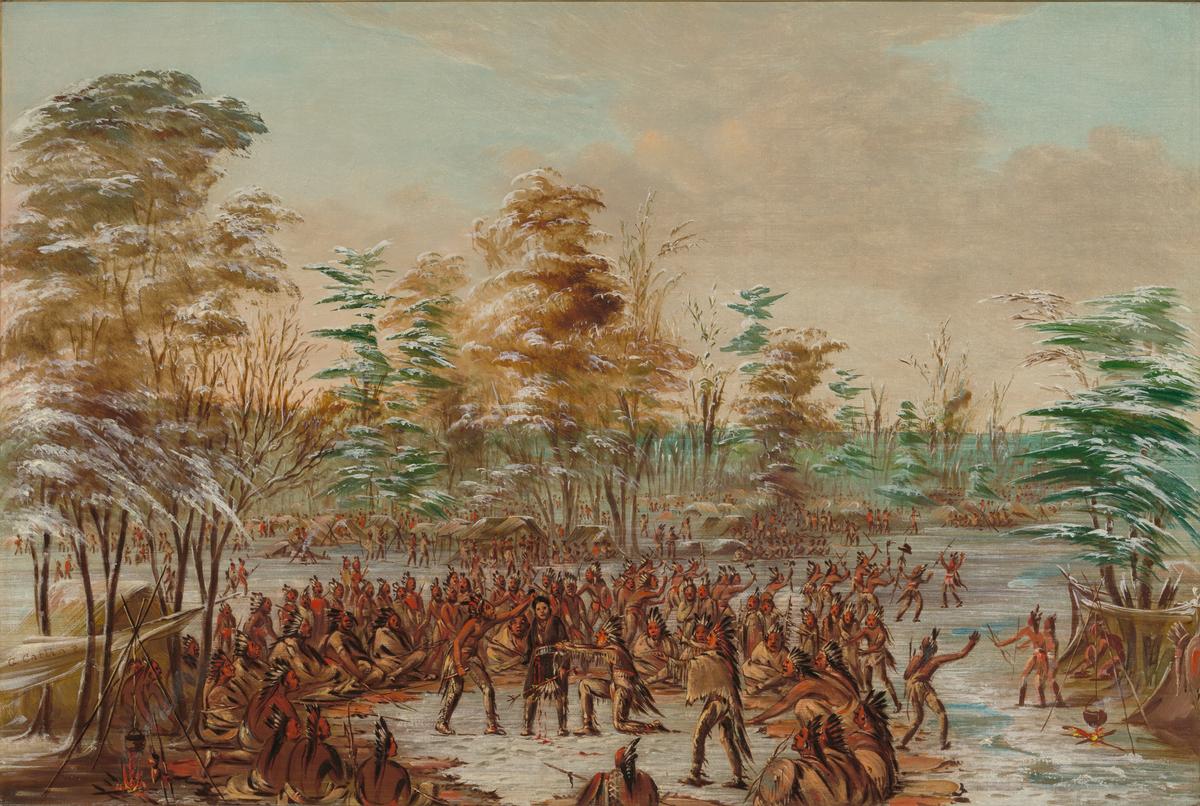
The explorer’s artificial iron limb was a symbol of strength as he traveled through North America.
By Brian D’Ambrosio
Henri de Tonti’s journey began on the sun-baked shores of 17th-century Italy, but the life he would make—its trials, its triumphs—played out far from the Mediterranean, in the wild heart of North America.
Lorenzo de Tonti (1602–1684) was a Neapolitan banker who devised the “tontine,” a type of life insurance involving subscriptions and shares. His son Henri (1649–1704) was born in Gaeta, in the Kingdom of Naples, where he inherited his father’s ambition but lived in exile in France. There, the young man remade himself as a soldier, a survivor, and a man who carried an iron hand into history.
Soldier Turned Explorer
Lorenzo’s innovative financial scheme brought him notoriety and misfortune. Political winds in Naples turned against him. The family found refuge in France, where young Henri grew up navigating the glitter and uncertainty of Louis XIV’s court. It was in this world of opportunity that he would learn resilience.

The young de Tonti joined the French military and, in the crucible of Sicily during the Franco-Spanish wars of the 1670s, lost his right hand and part of his forearm to a grenade. Many men might have ended their careers there. De Tonti did not.
He fashioned an iron prosthesis, covered it with a glove, and pressed forward. It was practical, yes, but it became also a symbol. Among French colonists and Native American peoples alike, the iron hand became a mark of strength, earning admiration and, sometimes, whispers of the supernatural. One oft-repeated account captures both de Tonti’s grit and the aura surrounding his iron hand. During tense negotiations with the Iroquois near present-day New York in the 1680s, tempers flared and violence threatened to erupt.
De Tonti stepped forward, raised his metal hand as if to calm the warriors, and, in the scuffle that followed, the prosthesis was cut open, spilling blood. The astonished Iroquois reportedly recoiled, believing the iron limb to be part of his body, and their hesitation helped avert bloodshed.
Whether embroidered by time or not, the scene illustrates how his maimed arm—once a mark of loss—became a source of mystique, a weapon as much psychological as physical.
Claiming the Mississippi
In 1678, de Tonti’s path turned outward. He joined René-Robert Cavelier, Sieur de La Salle (1643–1687), as part of the grand French project to explore and claim the interior of North America. The stakes were immense: furs, alliances, and the expansion of France’s empire, all in the shadow of Spanish and English ambitions. La Salle needed men of endurance, judgment, and loyalty, and de Tonti proved indispensable.
The journey was punishing with endless waterways, portages, and bitter winters. Each day tested the limits of the men and their supplies. Yet de Tonti’s unflinching steadiness kept the expedition moving. Where others wavered, he provided calm, pragmatic leadership.
In 1682, La Salle’s expedition reached the mouth of the Mississippi River. There, a cross was planted, a column raised, and France claimed the vast watershed, naming it “Louisiana” in honor of Louis XIV. Whether de Tonti himself reached the Gulf is uncertain; some accounts suggest he remained upriver due to illness. What’s certain is that without his guidance, diplomacy, and tireless labor, France’s declaration might have been little more than ceremony.

De Tonti negotiated with Native American leaders, managed supplies, and resolved tensions among the French party. His iron hand, a physical testament to endurance, earned him respect and authority—a subtle tool in diplomacy as much as it was a prosthetic.
In 1683, he helped establish Fort St. Louis on the Illinois River, on a sandstone butte near present-day Starved Rock State Park. The fort became a refuge, a trading center, and a place of diplomacy, drawing Native American allies and serving as France’s northern anchor in the Mississippi Valley. Three years later, he founded Arkansas Post on the Arkansas River, which would become the first capital of the Arkansas Territory (1819–1821).
Loyalty Beyond Death
When La Salle was murdered during a Texas expedition in 1687, de Tonti refused to abandon hope. He mounted an expedition to search for his commander, traveling hundreds of miles through hostile territory. Though he never found La Salle, the attempt revealed his courage, loyalty, and determination—qualities that later French leaders relied on as they established Louisiana’s coastal colonies.
De Tonti spent his final years aiding French settlements along the Gulf Coast, including Mobile, Alabama, and Biloxi, Mississippi. Disease, harsh climate, and tenuous supplies marked this period. In September 1704, de Tonti succumbed to yellow fever near the Mobile River, his grave unmarked. His life ended quietly but left a lasting imprint on a continent still in formation.
The forts he built, the alliances he forged, and the steadfastness he embodied helped ensure that French Louisiana endured at a time when it might have easily collapsed.
Today, his name persists across the Mississippi Valley. Tonti Township and the community of Tonti in Illinois, Tontitown in Arkansas, and the Arkansas Post National Memorial stand as reminders of a man who navigated rivers, cultures, and empires with an iron hand and unwavering resolve.
Henri de Tonti was more than La Salle’s lieutenant or a French soldier. He was a bridge between worlds, a stabilizing presence in uncertain lands, and a man whose literal and symbolic iron hand carved a name into the continent itself.
Brian D’Ambrosio is the author of Italian-Americana: Explorers, Entertainers, and Eccentrics. https://www.amazon.com/Italian-Americana-Entertainers-Eccentrics-Brian-DAmbrosio/dp/110592811X
Interview with Brian D’Ambrosio on the Italian American Stories Podcast: https://www.youtube.com/watch?v=of7BHc4uc7s
Brian D’Ambrosio’s recent historical profiles, including biographies of photography baron George Eastman and the creator of Dick Tracey, Chester Gould: https://www.theepochtimes.com/author/brian-dambrosio

 Brian D'Ambrosio